Posts

Belief in the reality of unreal :4.

Image
Thursday, Dec 19,  2013. Vedantham : Belief in the reality of unreal : Mandukya Upanishad. Chapter-4. Karika-75. Part-4.  Mind transcended is ego annihilated. It is for the ego-centre that we have the world of ignorance experienced in terms of birth and death; joys and sorrows; success and failures, etc. Once the ego has been ended, there can be no more reincarnations fo the 'jiva' ( jivatma ).  The very purpose of this endless pilgrimage through repeated incarnations is but to rediscover ourselves. Once the hidden 'Self ' has been discovered there is no more of this hide and seek play. When you have discovered yourself to be nothing other than Self, no more can you, the self, have the destinies od rebirth or death. END. 
Belief in the reality of unreal :3

Image
Sunday, Dec 15,  2013. Vedantham : Belief in the reality of unreal : Mandukya Upanishad. Chapter-4. Karika-75. Part-3.  Birth is but a chance or occasion given to the mind to earn experiences which in its ignorance had demanded for itself in its past actions, thoughts and motives. Having realised the Self-hood, it shall no more plan or act, wish or will for any more patterns of circumstances wherein it can gain its necessary doses of experiences. As such the entity who has thus rediscovered himself to be nothing other than the Self has no more any need to visit this realm of ignorance. Continues...

Belief in the reality of unreal-2.

Image
Wednesday, Dec 11, 23013. Vedantham : Belief in the reality of unreal : Mandukya Upanishad. Chapter-4. Karika-75. Part-2. The  deluded has a persistent belief in the reality of the pluralistic world of sense-objects which are, in fact, unreal. Corresponding to this blind belief,there is no external world-of-sense-objects other than the mind through which when Consciousness is projected out, it gets, as it were, seemingly dispersed into various projections. In the case of one who, through ''Upasana" ( devotion ), has integrated his mind and has brought such a prepared mind to the study of the "Sasra-s" ( to the deep and sincere reflections upon the teaching ) and to meditate upon these transcendental ideas, the mind is transcended  and Self is experienced. He then realises the total absence of duality. Such a one, says the "Upanishad-s," shall no more be born again since there is in him no more reasons to be born. Continues.....

Belief in the reality of unreal: 1.

Image
Saturday, Dec 07, 23013. Vedantham : Belief in the reality of unreal : Mandukya Upanishad. Chapter-4. Karika-75. Part-1.  "Man has a mere persistent belief in the reality of un-real. There is no duality. One who has realised the absence of duality is never born again as there remains, no longer, any cause for such rebirth." In this karika, a conclusive statement to prove to us why the pluralistic world, though unreal, is still persisting  in  our perception. It is because of a persisting belief ( "Abhinivesam" ). The real strength and beauty of this karika, unfortunately, cannot be translated into or conveyed through the English vocabulary. Abhinivesam is not merely a persistent belief, but we may say that it is an intense mental pre-occupation with an ardent faith in a false knowledge sustained and nurtured by a totally laughable ignorance. Abhinivesam also spells the ruin of the individual who maintains this belief. Continues...

Peak of perfection ( "What is our relationship with the Lord." ) :

Image
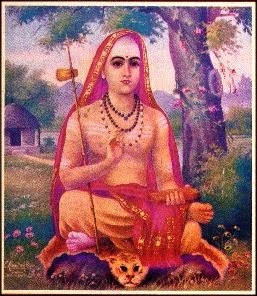
It must also be clear to us that all three schools of philosophy are not competing and contradicting theories, but that each explains a necessary stage we must pass through in our slow  pilgrimage to the peak of perfection. It is only intellectual pundit-s who quarrel and seek to establish one or the other declaration and fight over them. In fact, the moment we step on to the path of spiritual Sadhana we realise that these three are the three way-side inns for spiritual pilgrims to rest and proceed ahead. Every pilgrim must first visit "Swami Madhavacharya," from where he proceeds to worship "Swami Ramanujacharya," and then alone can he reach the portals of "Vedantham" and recognise himself to be no other than "Swami Sri Adi Sankaracharya" himself. Therefore, stop quarrels. Let us act. Let us embark on the pilgrimage, and see for ourselves "What is our relationship with the Lord." End.   

Our Relationship with the Lord : -7.

Image
Friday, Nov 29, 2013. Vedantham : Our Relationship with the Lord : -7. Hanuman :- Hanuman says, "O  Lord, at moments when I  am steeped in my body consciousness I  am Thy slave;  when  I  identify with the mind and intellect, i.e.; as a Jeevatma,  I  am the part of Thee;  and when in my Svarupa, that is as the Spirit, I  am Thyself." Thus our relationship with the Lord can be explained in three different ways according to state of our Self-Consciousness. There are moments when even the greatest Seer is conscious of the sorrows of physical pains and even of the inclemencies of the weather. At such moments even a Jnani falls prostrate at His feet and mentally seeks the mercy of the Lord. There are moments when he is conscious of some inner mental agitation or irresistible poetic outbursts or high intellectual flight and recognises within himself a might and a power almost equivalent to that of the Lord. It is ...

Our Relationship with the Lord-6.

Image
Perfect Identity : To such a one in his perception he is but 'That'. As that he has once for all dropped all his wrong identifications with his body or the psychological entity.  He becomes 'Pure Spirit', and as 'Spirit' his relationship with the 'Lord'is one of "PERFECT IDENTITY" : there cannot be perfect relationship, as "Relationship" denotes the existence of at least a pair of things. Though the "Vedanta student sought Truth within himself, yet in his discovery of it as though in his own bosom, he experiences himself ad the "Whole". This type of student is served by the school of philosophy  called "Non-Dualism"of Swami Adi Sankaracharya. These three kinds of our relationships with Truth have been beautifully described in "Ramayanam", when "Hanuman", the greatest devotee of "Sri Ramachandra"explains his relationship with "Sri Ramachandra". Next...